
Starting a Salem Property Records Search
Start with the strongest clue you hold. An address, an owner name, or a tax-map number opens the first door. Salem property records then split by purpose. The Real Estate Department's DataScout portal carries ownership details, assessed values, mapping, aerial imagery, and sale statistics, while Salem GIS handles spatial lookups by address, street, or Tax ID. For deeds, deeds of trust, liens, and releases, the Circuit Court clerk and Virginia SRA are the record route. A name on the tax roll is a lead, never a substitute for the latest recorded deed. One number can bridge the offices. Save the map number, the lot or acreage wording, the owner of record, the bill number, and the deed reference as you go. Compare dates carefully. A deed recording date, a land-book year, a tax period, and a GIS update each describe different events, so a current-looking assessment should never settle a title or boundary question on its own.
- Search the address or owner in DataScout or Salem GIS, then record the Tax-ID and legal description.
- Match that parcel to the annual land book and note its tax class, bill number, values, and deed reference.
- Use the owner name, deed reference, or description in Virginia SRA; ask the Salem Circuit Court clerk for a public terminal or image if needed.
- Check the tax map, subdivision plat, zoning, flood, and city-limit layers in GIS for location context.
- Contact the Treasurer about a balance, the Real Estate Department about an assessment, or the proper clerk about an official copy.
Salem Offices Behind the Records
Salem is an independent city with its own systems. It is separate from Roanoke County's assessment and deed operations. The City Real Estate Department maintains assessment and ownership information. The Salem Circuit Court clerk holds the land-record index and the instruments themselves. The Treasurer takes real-estate tax payments. Community Development keeps the GIS maps, tax maps, and plats. Building Inspections and Planning/Zoning keep separate permit and case records of their own.
Salem Circuit Court Clerk
2 East Calhoun Street
Salem, VA 24153
540-375-3067
Real Estate Department
114 North Broad Street, City Hall
Salem, VA 24153
540-375-3058
Community Development / GIS
21 South Bruffey Street
Salem, VA 24153
540-375-3032
DataScout, GIS, and SRA Have Different Jobs
Salem's Real Estate portal points to DataScout for detailed ownership and assessment information. GIS handles spatial lookup and map layers. Virginia SRA covers circuit-court land records, with image access set by the local clerk. These systems share no single search index. A GIS feature can locate a tax parcel. But it shows limited owner detail. DataScout adds assessment context. The clerk's recorded instrument remains the legal evidence of a conveyance. Salem's official property-search page describes the DataScout information offered. When the live interface will not load, the fallbacks are the local landing page, a GIS result, the land-book PDF. The clerk counter also serves as a fallback. See the Salem DataScout entry page for the City's current link to its assessor search.
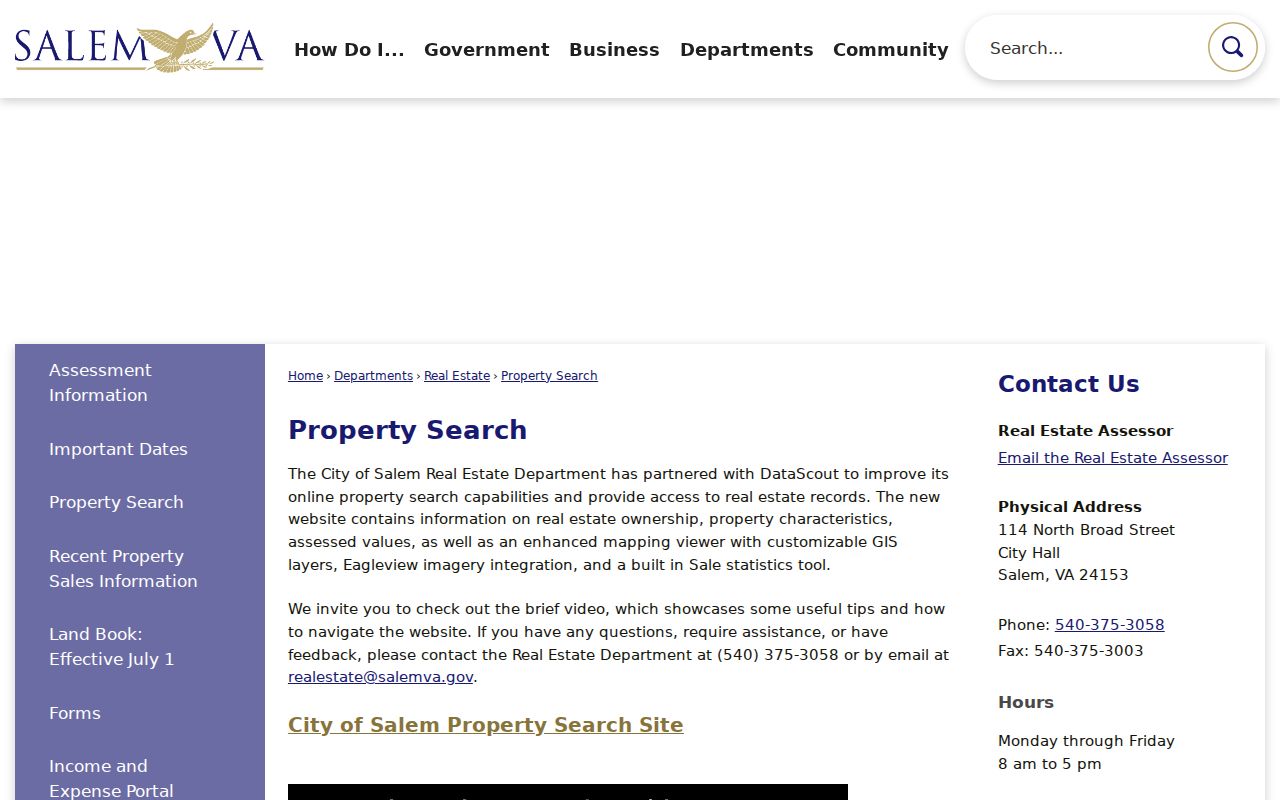
This entry point separates the assessment portal from the GIS map and the Circuit Court deed index.
Salem Property Records by Record Type
Salem property records span annual assessments, tax payments, recorded land instruments, parcel maps, plats, permits, and zoning applications. The custodian and access path depend on the record. A tax bill never sits in the deed index. A plat PDF is not a survey. This table matches common questions to the proper Salem office before a search begins.
| Record set | What it documents | Salem custodian | Access path |
|---|---|---|---|
| Deeds and land instruments | Transfers, deeds of trust, easements, liens, releases, judgments, and plats affecting title | Salem Circuit Court clerk | Virginia SRA where enabled; clerk counter for images and certified copies |
| Assessment and land book | Owner and mailing address, map/zone, legal description, tax class, land, improvements, total, deed reference | Salem Real Estate Department | DataScout and annual PDF land books |
| Tax payment and delinquency | Billing periods, payment, delinquency, and judicial-sale process | Salem Treasurer | Online payment, mail, phone, or counter |
| GIS, tax maps, and plats | Parcel geometry, map grid, zoning, flood, utilities, lot and subdivision context | Community Development/GIS | Public GIS site and downloadable PDFs |
| Permits and zoning | Address-keyed permit history, applications, status, inspection, zoning review | Building Inspections and Planning/Zoning | Legacy search, Cityworks, and office help |
Use the Salem deed-records route to identify the instrument behind a transfer. Confirm what is currently owed with the Treasurer, not a static tax amount. The tax and value pages treat assessment and billing separately.
Salem Land Books Preserve the Tax Roll
Salem publishes a yearly land-book PDF. It is a strong fallback when DataScout is down. It is also a valuable record in its own right. The 2026 book lists owner name, mailing address, row number, legal description, map and property-use codes, state class, bill number, taxes, land value, improvement value, total, and deed reference. A line like map 231-2-2, "LT 3 BLK 2 YORKSHIRE COURT," with reference 060003912 shows how a map key plus subdivision wording can lead toward the parcel's recorded instruments. Land-book rows also name Beverly Heights, Forest Lawns Annex #3, Orchard Court, B&O Land Co. divisions, Yeakel Plat, and West Hill Cemetery. These are not interchangeable neighborhood names. Some are plats, company divisions, parent tracts, or landmark descriptions. Keep the wording exactly as printed when searching another year, a plat index, or the deed record. The book is a tax-year snapshot, not a closing-day ownership feed.
Salem Plat Books and Map Sheets
The City's subdivision-plat collection reaches back to Salem's incorporation in 1968. Files are named with an "S" plus book and page, such as S2 33. The tax-map index covers sheet runs including 001–030, 101–134, 157–191, and 303–318. Land-book map IDs include 121-3-1, 164-1-10, 231-2-2, 259-3-4, and 44-3-10. The City publishes no parser for those numbers. Copy the exact format, and ask GIS when a match is unclear. Tax maps and plats connect a description to a lot and its surrounding streets. Salem itself warns that tax maps are for tax identification. They are not legal use, nor a substitute for a survey. A later correction deed, resubdivision, vacation, easement, or field survey can change what an older plat appears to show.
Salem’s Boundaries Changed the Record Trail
Old Salem deeds often carry locality names that no longer exist. The town dates to 1802. It became the Roanoke County seat in 1838. It gained Roanoke College in 1847. It welcomed the Virginia & Tennessee Railroad in 1852. Growth continued through annexation. South Salem joined in 1953. An eastern tract followed in 1960. The Town of Salem became the City of Salem on December 31, 1967.
That shift matters for a property search. Deeds recorded before 1967 may name Roanoke County or the Town of Salem in the legal description. The City GIS offers an Annexation 1927–1967 time-lapse layer. It pairs well with an old plat, a newspaper clipping, or the deed itself. The current City Limits layer confirms present jurisdiction. Treat this history as a search clue only. It does not rewrite the old instrument. Nor does it fold neighboring county records into Salem’s current tax roll. Read Salem’s municipal history and compare the former boundary with the current map.

This page is history, not a parcel record. Use its dates to sharpen search terms when pulling deeds and plats from the recorder.
Annual Assessment Shapes Salem Values
Salem reassesses property every year. Virginia requires local assessments at 100% of fair market value, and the City says its assessor reviews values annually to keep the tax burden fairly distributed. The land book splits land, improvements, and total value, so you can see which component moved between annual editions. The assessor applies sales comparison, cost, and income approaches. No method turns a tax roll into an appraisal. Appeals are possible too. The administrative appeal form lists three grounds: a value above fair market value, unequal assessment against similar property, or inaccurate property information. Dates matter here. Its sample hearing date is dated, so ask the Real Estate Department for the current filing calendar. An objection to the Council tax rate is not an assessment appeal.
Value is often the real question. The Salem property-value page separates an assessment from a recorded sale.
Salem Tax Bills Have Their Own Dates
The Treasurer bills real estate in two periods. January 1 through June 30 is due June 5, and July 1 through December 31 is due December 5. The published rate sits at $1.16 per $100 of assessed value. These dates are not the deed date. They also differ from the assessor’s annual update. Go to the Treasurer for a current balance and payment status, since the land-book tax column may lag later payments, penalties, interest, credits, or corrections.
Salem offers online, mail, and in-person payment. In-person payment takes cash, check, money order, and cards. The City’s payment page reports no convenience fee for its online option and a $40 returned-check fee. Terms can change. Confirm everything on the official Treasurer payment page before sending funds. The page states the official instructions that pair with the public tax records.
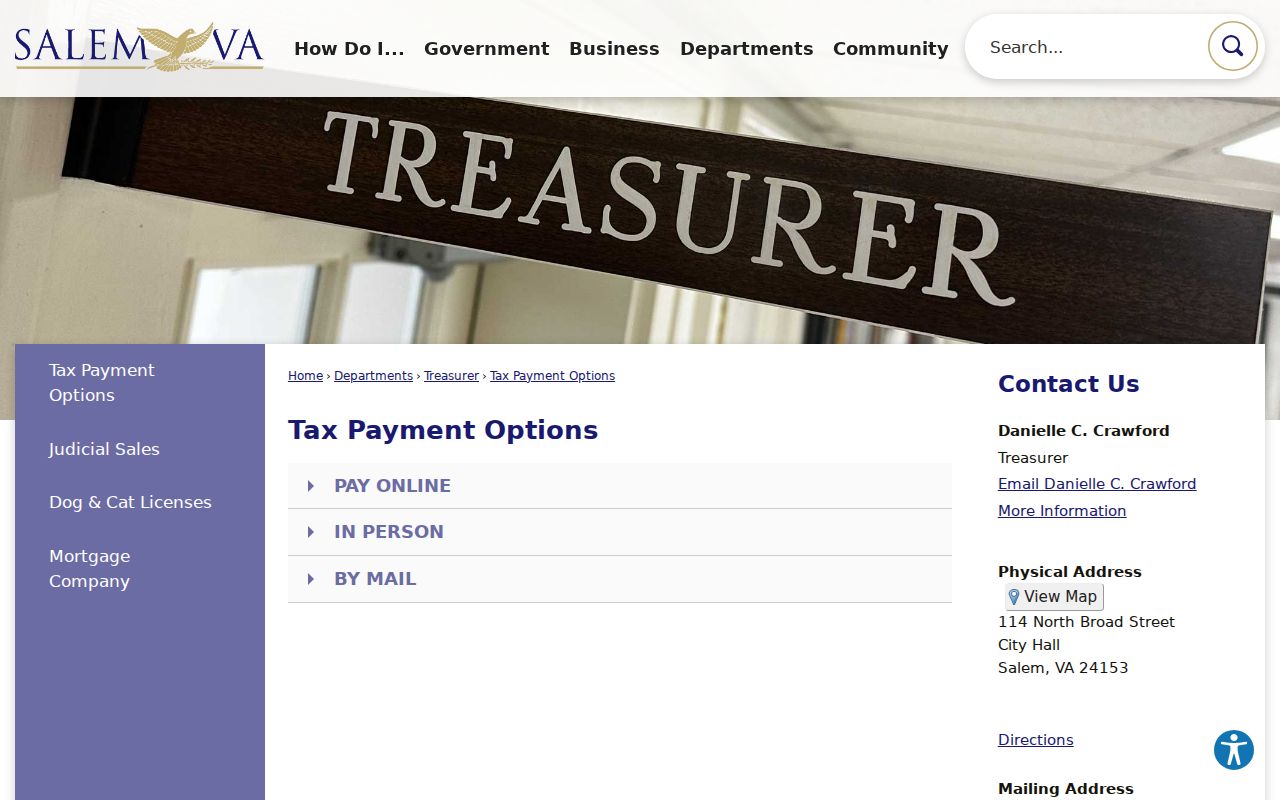
Payment pages explain how; the land book shows what.
Salem Delinquency Can Reach Court
Under Va. Code §58.1-3965, Salem may begin judicial-sale action for real estate delinquent more than two years as of December 31. The City says a parcel on a review list is not automatically scheduled for sale. A bill in equity can take months, and the owner may redeem before the sale by paying taxes, penalties, interest, and costs. Confirm status with the Treasurer and Salem Circuit Court instead of treating an old list as a final sale notice.
Check the Treasurer’s judicial-sales page, the local civil docket, and recorded lis pendens, orders, trustee’s deeds, releases, or tax-sale instruments. A court case and a land-record entry answer different parts of the process. The source page names Treasurer Danielle C. Crawford and provides a local phone contact.
Review Salem’s judicial-sale process for the current official description.
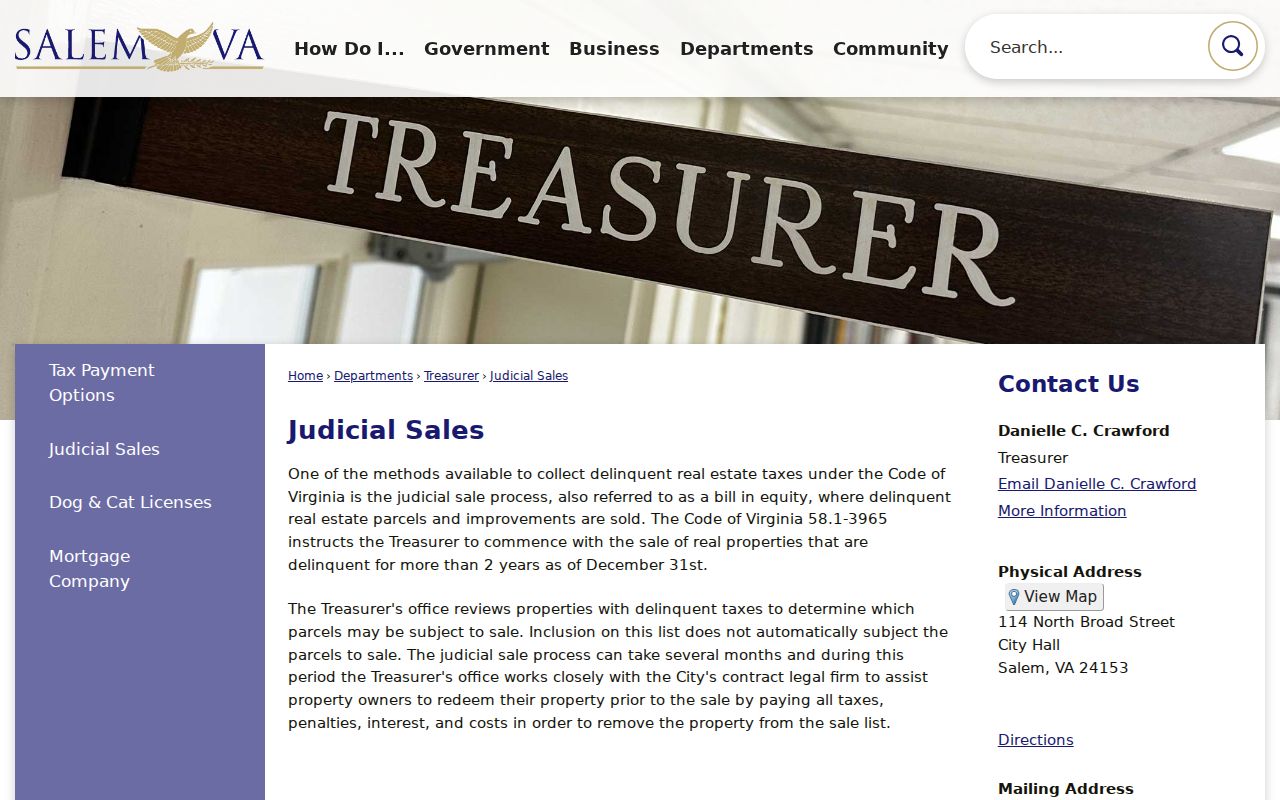
The image serves as a process reference only. Call the Treasurer's office to ask about a specific parcel, a balance owed, or where a delinquency currently stands in the court pipeline.
Salem Permits Add Building History
Building permits and zoning cases add a different kind of evidence to Salem property records. The public permit search accepts Permit Type, Permit Number, and Service Address. Older permits may be missing. The City cautions that the database is incomplete for early jobs, and the legacy search cannot request or pay for permits. For an older job, call Building Inspections at 540-375-3036 with the service address, likely work type, and approximate year.
Planning and Zoning handles permit review, zoning interpretation, home-occupation permits, alleged violations, special exceptions, and ordinance changes. Current Cityworks pages cover application, status, document, fee, and inspection functions. A permit documents regulated work. It does not prove title, quality, or condition. GIS zoning and flood layers add parcel context. Recorded deeds remain the ownership source.
Virginia FOIA Fills Some Salem Gaps
Virginia's Freedom of Information Act, Va. Code §§2.2-3700–2.2-3715, opens a request path for public-body records. It applies to records not already posted, subject to exemptions and other record laws. A focused Salem request might seek a permit log. It could also cover a GIS layer description, zoning case material, or administrative correspondence. Identify the City custodian, the parcel or address, the record type, and the date range. Ask for an electronic copy and a cost estimate if the search is extensive. The act allows charges based on actual access, search, and duplication costs.
FOIA does not override vital-record restrictions, voter-record limits, or sealed court files. It also does not override the clerk's land-record image process. Request a deed image through the Circuit Court clerk. Do not treat it as a broad administrative request. The statutory page governs the access and cost rule. Read Virginia's FOIA access section before preparing a targeted request.
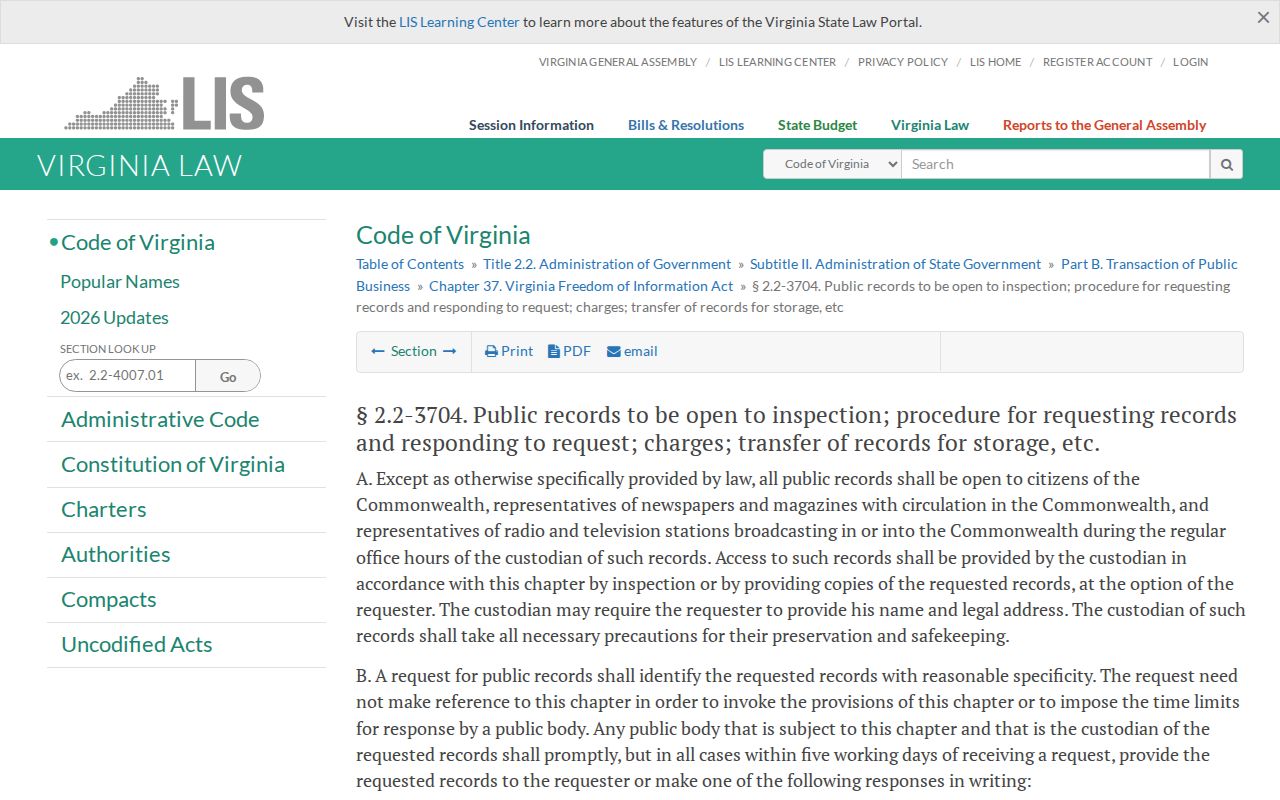
One limit matters here. The statute reaches administrative records, but it cannot force a public body to create a new record or hand over a title opinion.
Salem Library Sources Extend a House History
An old deed often supplies a name or subdivision without any story. Salem Public Library can fill that gap. Ancestry Library Edition runs on site and covers land, court, probate, census, directory, and vital collections. Digital Sanborn Maps trace old buildings and street form. HeritageHub spans obituaries and death notices from 1704 onward. The Roanoke Times Collection and Access World News add notices and local development accounts. No exact run of Salem city directories is listed. Check each collection’s catalog before assuming year coverage.
Yearbooks, Virginia Room links, the Salem Museum, and the East Hill Cemetery GIS can resolve an old name or landmark description. Pair those clues with the plat, the land book, and the deed itself. A newspaper story explains a house’s use. It does not establish who held title. Read property records and local-history collections together as complementary evidence.
What Salem Property Records Can and Cannot Tell You
Salem property records answer many questions, but not every one. The tax roll names the current owner of record. Official records also carry the City's legal description, recorded conveyances, assessed values, payment accounts, mapped parcels, and permit entries. Each one has its own date and purpose. The assessor's value is a tax appraisal, not an offer price. A permit does not prove current use. A tax map fixes no legal boundary. The deed index becomes a complete title search only when the relevant transfers and related instruments are reviewed.
Lawful use. Salem property records support ownership research, property diligence, tax questions, and civic review. A record search does not replace a title professional or licensed surveyor. Do not use an owner name or mailing address to stalk, threaten, harass, trespass, or harm anyone.