
Values in a Salem Assessment Record
Salem's assessment material separates land, improvements, and total value. The annual land book carries more than numbers. It lists the owner and mailing information, legal description, map or zone, property use, state class, bill number, taxes, and a deed reference. It also lists a deed reference. Those fields put a dollar figure in its record context. A total alone tells you little. Screen labels can vary, though. Treat the land book as the reference copy when the city portal words things differently. See Salem's annual land-book page for the public assessment roll and its parcel references.
| Value | What It Is | Where |
|---|---|---|
| Land value | Assessment assigned to the parcel’s land | Salem land book / Real Estate search |
| Improvement value | Assessment assigned to buildings or other improvements | Salem land book / Real Estate search |
| Total assessed value | Combined assessment used with the tax rate to calculate a gross levy | Assessment record |
| Sale consideration | Price stated in a transfer record, when available | Recorded deed or verified transaction data |
Virginia aims assessments at 100% of fair market value. Even so, an assessment is a mass-appraisal conclusion for one assessment date. A prior sale may have involved different conditions. It may also reflect property improvements, financing, or a different market moment. Assessed total and recorded sale price therefore answer related but distinct questions.
Land and Improvements Tell Different Stories
Land and improvement values tell different stories. The split shows which part drives the total. A land figure is not a bare-lot asking price. It is the city's assessment of that parcel within its valuation system. An improvement figure covers assessed buildings and other structures. Either part can change. Salem's 2026 land book makes the split explicit, right alongside the total and map information.
Check the legal description and map number as well as the owner name. The map ID ties the record to a mapped parcel. A deed reference can lead you into the Circuit Court Clerk's index. Typos and older identifiers can make a search return nothing. Verify the lot before comparing any figures.
Find a Salem Property Value by Parcel
Salem's Property Search page links to DataScout, the city's public property-search provider. Use a parcel number where possible. It covers ownership, properties, values, maps, imagery, and sales statistics. Field labels and coverage are the portal's to define. When a specific field is missing, check the result. Compare it against Salem's land book or Real Estate office. Start at the City of Salem's property-search page for the official portal link. Office contacts are listed there too.
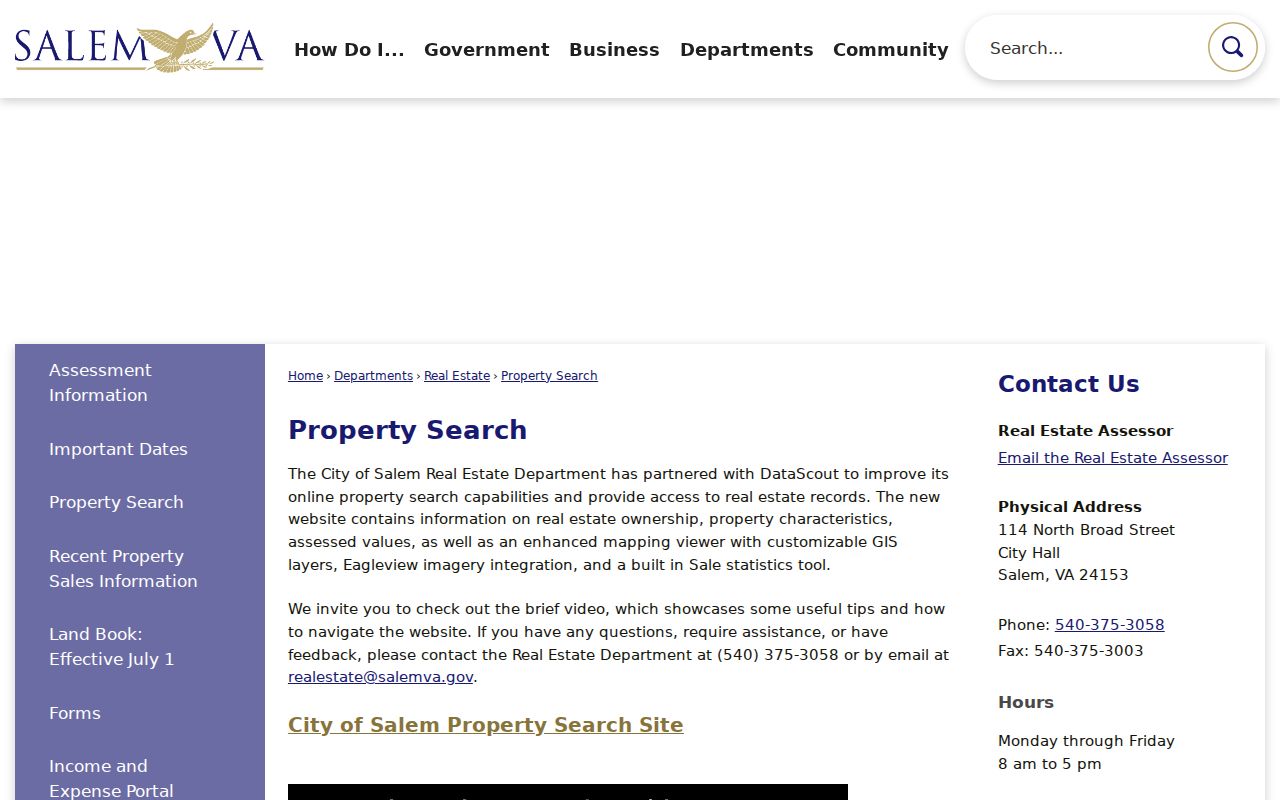
The City page routes you to the portal. Before trusting a figure, confirm the parcel and assessment year actually match the question you are asking.
- Search DataScout by Salem street address or parcel identifier; if the address is ambiguous, compare map location and legal description.
- Read land, improvement, and total value separately, and note the tax year or land-book year attached to the result.
- Use the deed reference and legal description to distinguish the parcel from a similarly named street address or a related lot.
- For a transfer price, locate the recorded deed or ask the Real Estate office which sales information is available; do not treat assessed value as the closing price.
- Assessed value
- The value placed on the city’s assessment roll and used as the basis for property-tax calculation.
- Market value
- The fair-market concept the local assessment is intended to reflect at the relevant valuation date.
- Appraised value
- An estimate prepared for a particular assignment, often by a qualified appraiser; it is not interchangeable with the tax assessment.
- Assessment level
- The relationship between assessed value and market value. Salem’s stated approach is assessment at 100% of fair market value.
Salem Updates Assessments Annually
Salem reassesses every year. The City FAQ describes assessments as made at 100% of fair-market value. Annual work can change a property record even when a parcel has not sold. The city relies on three valuation approaches. They are sales comparison, cost, and income. Which one carries the most weight depends on the property type and the information available, so the result is a valuation method rather than a promise that any figure will match a particular offer or asking price.
Write down the assessment year for each entry when comparing values across years. A change may reflect new market evidence. It may also reflect physical updates, corrected characteristics, or new classification information. Tax bills move for their own reasons. Rate and levy changes move the bill, not the value.
Property Use and State Class Add Context
Salem's land book pairs a property-use field and a state-class field with the map number and legal description. Classifications explain how an entry is categorized. They are not independent valuations. Never substitute them for the stated land, improvement, or total figures. The tax roll lists them for every parcel. If a record describes a use or physical property the parcel does not actually contain, ask Real Estate which source information supports the entry and how a correction request is handled.
Confirm identity with more than the displayed owner name. Compare street address, map ID, legal description, and deed reference. Match the assessment year too. Two Salem property values compare cleanly only when the parcels share similar characteristics. A class difference can distort the comparison.
A Salem Sale and an Assessment Need Context
A deed records a conveyance and fixes the legal description of what changed hands. The assessor's tax roll answers a different question. It states how the City valued the parcel for taxation. A Salem sale can still serve as market evidence. One transaction never settles the fair market value of another parcel, because lot size, improvements, condition, location, easements, and the sale date all shape price. DataScout publishes sales statistics for the city.
Older transactions call for names. For a historic transaction, search grantor and grantee names or the deed reference in Virginia's land-record system. Salem's Circuit Court Clerk holds the deeds and deeds of trust, and online access depends on what the clerk enables. Treat the two sources as complementary. The legal instrument controls what was conveyed. The assessment record answers how the city valued it.
For a step-by-step route to the recorded instrument, see the guide to Salem deed records. For the tax rate, bill dates, payment methods, and the gap between value and amount due, use the Salem property-tax guide and the Treasurer payment information page.
Questions About a Salem Assessment
Salem's appeal information names the grounds. A value above 100% of fair market value is one. Unequal assessment is another. Incorrect physical information counts too. A high tax rate is a different complaint. That grievance attacks the rate, not the assessed value of the property. Start by checking the parcel number, land and improvement values, the property description, and the sales or physical evidence behind the valuation.
The appeal material online includes an older form with a 2009 hearing example. That historical date means nothing for a current filing. Contact Salem Real Estate at 540-375-3058 or realestate@salemva.gov, 114 N Broad Street, to confirm current procedures and deadlines before submitting anything.
What a Salem Assessed Value Cannot Prove
A city assessment is a public valuation for the local tax system. It is not a private inspection. It is not a title opinion, a current listing price, or a prediction of a future sale. Appraisals answer other questions. So do Zestimate-style estimates. A public roll can also lag a recently recorded deed or a physical change, because the land book and the deed index update on separate cycles. No fixed interval governs those updates. If an entry looks inconsistent, ask the Real Estate office which year and parcel it represents.
Value vs. price. A Salem assessment does not predict what a property will sell for. For a purchase, financing, estate, or other decision that depends on a current appraisal, consult a qualified appraiser and rely on the current record only for its stated assessment purpose.