
What Salem Property Tax Records Show
Salem's annual land book is the best public sample of the tax roll. Each row lists the owner of record and mailing address. It also covers map and zone, property-use code, state class, bill number, tax amount, land value, improvement value, total assessed value, and a deed reference. That is a lot of data on one line.
The Real Estate Department's DataScout page advertises ownership details. It also promotes property characteristics, assessed values, mapping, imagery, and sale statistics. The live record card itself is not accessible. So treat its labels as unconfirmed until the assessor verifies them.
| Field | What It Shows | Where |
|---|---|---|
| Land and improvements | Separate assessed components used to make up the total. | Salem land book / Real Estate |
| Total assessed value | The annual tax value; Salem assesses at 100% of fair market value. | Real Estate Department / DataScout |
| Tax class and use | Classification and property-use clues; detailed exemption fields were not verified. | Land book / assessor |
| Bill number and tax amount | Tax-year account and amount printed in the land-book row. | Land book; confirm current balance with Treasurer |
| Payments and delinquency | Amount paid, due, or under collection for the account. | Salem Treasurer |
Salem's FAQ says assessments sit at 100% of fair market value. They get reviewed each year. The number is a tax estimate fixed on the appraisal date. It is not a forecast of a sale price. A deed sale price, by contrast, is a transaction fact in the recorded deed trail.
The land book's tax amount has the same caution. Payments, credits, penalties, interest, and corrections can all change an account after the book is published. The printed figure may not equal the live amount due.
Salem Reassesses Property Each Year
Salem's Real Estate Department opts for annual reassessment. Virginia law requires local assessments at 100% of fair market value. The City reviews values each cycle to spread the cost of public services in proportion to property worth. Its stated valuation methods include sales comparison, cost, and income approaches. Comparable sales carry the most weight. Yet a distressed or unusual transaction may not reflect a typical market price. The assessor studies conditions and property data rather than copying one number.
Physical details may also be updated from an exterior review and other available data. The FAQ notes that an owner can refuse interior entry. Access tends to improve accuracy, though. A value can shift year to year for several reasons. The cause could be reassessment, a correction, a property-data change, or a parcel split. Before crediting the market alone, dig deeper. Compare the land and improvement components, the total, and the legal description.
Salem Land-Book Rows Separate Value and Tax
The 2026 land book lays out its accounting layers in columns. These include land, improvements, total value, tax amount, bill number, state class, map and zone, and deed reference. Always keep the year when you save a row. A static tax-year book is useful for comparing assessments and pulling a deed reference. The Treasurer's system holds the live balance, though. A printed amount may miss a later payment or adjustment.
When a street address is missing, pair the legal description with the map number. One row may read "LT 3 BLK 2 YORKSHIRE COURT." Another may name Forest Lawns Annex #3 or a remaining-acreage tract. Those phrases anchor the assessment to the right plat and deed. Salem publishes no full inventory of DataScout exemption fields or a complete schedule of local exemption categories. Ask the assessor about a specific code rather than guessing.
The annual book appears on the City's land-book page. Remember what a row is: a tax record. It is not a deed copy or a payment receipt.
Looking Up a Salem Tax Bill
Payment questions, account status, delinquency, and judicial-sale administration all run through the Salem Treasurer. The published pages do not document a full bill-lookup field list. The online payment screen may not search by any particular mix of name, street, or map number. So avoid assuming that it does. When you call, bring the tax ID and bill number. Also bring the owner name and legal description from the land book. A mailed invoice works too, since it carries an account identifier.
- Find the property’s map number, bill number, and owner in DataScout or the applicable land-book year.
- Ask the Treasurer to confirm the current balance, payments, penalties, interest, credits, or corrections on the account.
- Use the assessment record to understand land, improvement, and total values; ask Real Estate about a code or property-detail issue.
- If delinquency is mentioned, check the judicial-sales process and the Circuit Court case or instrument before treating a parcel as sold.
- Assessed value
- The City’s tax appraisal, intended in Salem to equal 100% of fair market value.
- Market value
- The assessor’s estimate of a likely sale between willing parties on the appraisal date.
- Tax rate
- The charge applied per $100 of assessed value; Salem publishes a real-estate rate.
- Tax lien
- A claim related to unpaid tax that may lead to court action; confirm status with the Treasurer and clerk.
Salem Payment Periods and Routes
Salem splits real-estate taxes into two billing periods. January 1 through June 30 is due June 5; July 1 through December 31 is due December 5. The published rate is $1.16 per $100 of assessed value. Those are billing facts, not a calculation of any parcel's balance. For paying, the Treasurer lists online, mail, and in-person routes, including a no-convenience-fee online option and cash, check, money order, Visa, MasterCard, or Discover at the counter.
Mail the top portion of the invoice with your payment and request a receipt. The listed address is Danielle Crawford, Treasurer, P.O. Box 869, Salem, VA 24153-0869. A returned check draws a $40 fee. Methods and processing details can change, so review Salem Treasurer payment instructions before you pay.
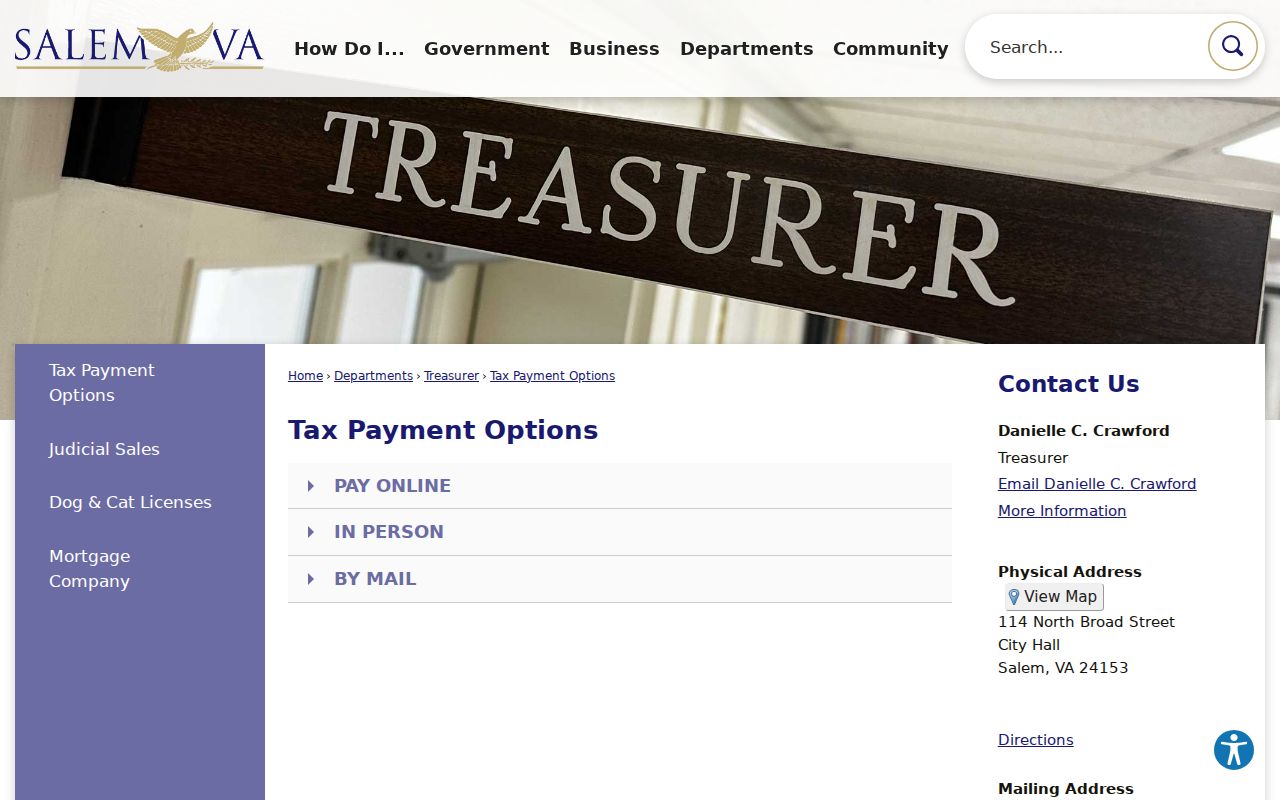
The payment options explain how to pay. The tax roll explains which year and parcel a charge belongs to.
Salem Delinquency and Judicial Sales
Salem’s official judicial-sale page says the Treasurer can begin a judicial-sale action when real estate is delinquent more than two years as of December 31 under Va. Code §58.1-3965. A property appearing on a review or delinquent list is not automatically scheduled for sale. The bill-in-equity process takes months, and the owner may redeem before sale by paying taxes, penalties, interest, and costs. A delinquency entry is a warning to check the case and account, not proof that title has transferred.
Check the Treasurer’s current notice and contact the office at 540-375-3024. For court status, search the local civil matter and compare any lis pendens, order, trustee’s deed, tax-sale instrument, or redemption record in the Circuit Court land records. Record dates and parcel descriptions matter because a map or owner name may have changed after a split or consolidation.
Read Salem’s judicial-sale procedure before drawing conclusions from a notice.
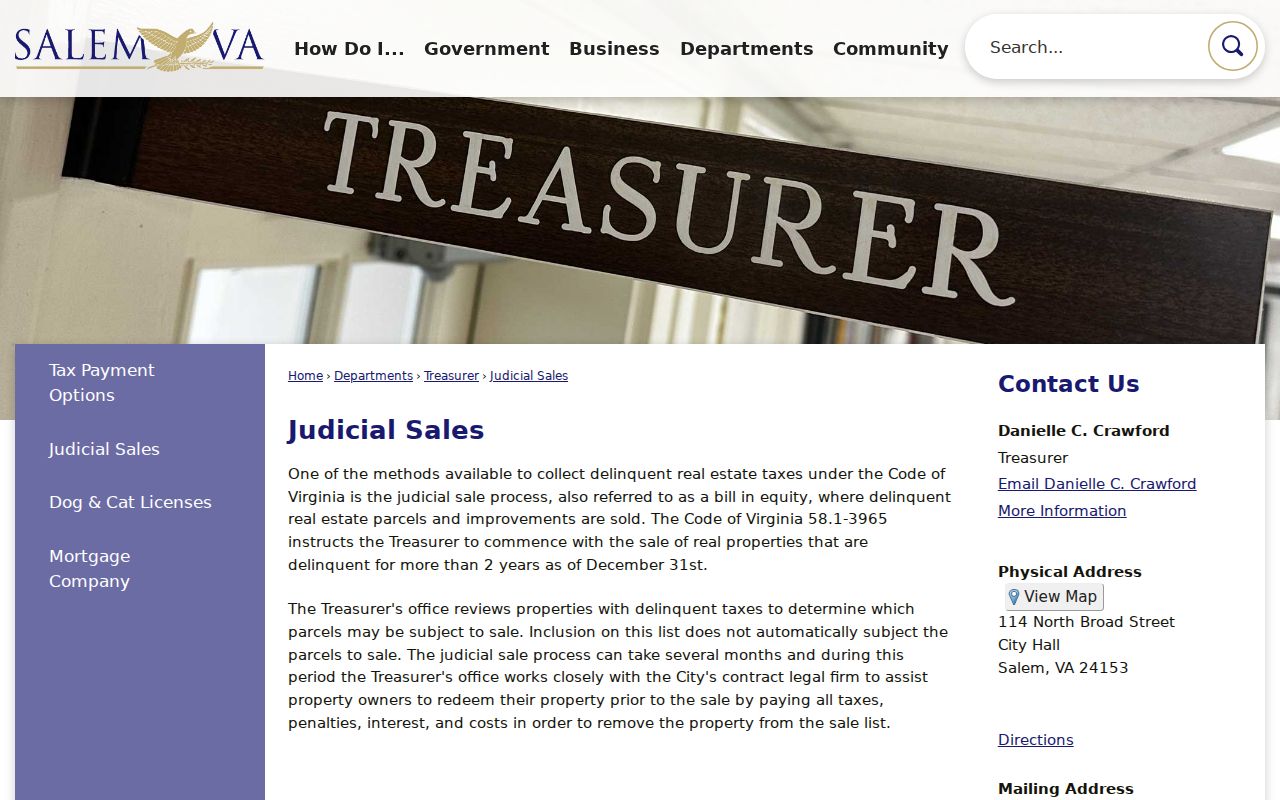
Call the Treasurer about the account itself. The court record tells you whether a legal proceeding has actually moved forward.
Appealing a Salem Assessment
Salem's administrative appeal form lays out three grounds for contesting an assessment. The assessment can exceed 100% of fair market value. The parcel may not be equally assessed with similar property. Or the City's property information may simply be inaccurate. Supporting evidence can take several forms. Options include comparable sales, a private appraisal, or corrected property facts. Staff may schedule an inspection. The form also says the owner is notified if a change is made. And it cautions that a complaint about the Council tax rate is not an assessment appeal.
The published PDF contains an old budget-hearing example. So the complete current appeal deadline calendar is not stated there. Call the Real Estate Department at 540-375-3058 to confirm the current filing window and submission steps. Never infer a current deadline from an older form example. For what the numbers mean apart from the bill or the appeal, the Salem property-value reference separates assessed value from sale price.
Check the current appeal window. Salem’s form supports value, equity, and property-data grounds, but its example calendar is old. Ask the Real Estate Department for the current deadline before filing; no current date was confirmed in the source materials.
Salem Tax Classes Need a Local Read
Salem's land book pairs a state-class code with property-use information. The GIS legend adds tax-exempt parcel context. The live DataScout exemption fields are not documented in these materials. A full local exemption list is not documented either. A code or a blank field belongs with the Real Estate Department. It does not belong with guesswork about a benefit. An exemption or special classification can change taxable liability while leaving the assessed market value untouched.
Read each class alongside its year, map ID, legal description, land value, improvement value, and total. The City's 2026 sample land-book material shows every element. Those elements sit next to the tax and bill reference. A live account may show a different screen or status. When a code conflicts with the property's recorded use, ask Real Estate how to challenge the underlying data. Ask the Treasurer separately about an amount due or a payment posting.
A value question means comparing the tax-year book, legal description, land and improvement components, and property data. A payment question means asking the Treasurer to check the account. Keeping those questions separate routes a Salem property tax records inquiry to the right office. It also avoids mistaking a static annual PDF for a live tax bill.