
Salem’s Owner-of-Record Entry
Salem's land book gives you a checkable view of the assessment roll. One row shows the owner name, mailing address, map and zone, use code, tax class, bill number, legal description, assessed values, tax amount, and deed reference. The live DataScout parcel card may display additional fields on its own update schedule. Identify the parcel with the fields you know first. Then compare the most recent clerk-recorded deed. Do this before calling the roll entry the current owner without qualification.
| Owner name | The owner named in the Salem tax roll for that land-book year. |
|---|---|
| Mailing address | The address used for tax notices; it may be a business, agent, trustee, or post-office box. |
| Situs address | The physical location used for search and mapping; the exact live DataScout card label was not confirmed. |
| Map and legal description | Tax-ID, zone/use, and lot, block, subdivision, acreage, or other legal wording. |
| Last transfer date | Not confirmed as a DataScout field; verify the latest recording date in the clerk’s deed record. |
| Deed reference | Land-book reference that can help locate the recorded instrument through SRA or the clerk. |
The owner of record is the name carried on the tax roll. It is not always worded like the name in the latest deed. A trust, an estate, or a company may appear in a different form. The mailing address may even belong to an authorized representative. Two owners can share a name. A parcel may also carry an old street description. The legal description and map number settle the question.
What Salem’s Tax-Roll Owner Means
Salem's assessment roll is an administrative record. It identifies property, values it for tax purposes, and routes billing notices. But it is not a recorded instrument. The 2026 land book shows the owner name and mailing address side by side. That makes it a solid starting point for a Salem property search. DataScout is the detailed path. The free annual PDF works as a stable fallback when the live system will not load. Read either one with its year attached. The tax entry can lag behind the newest deed.
The City's official property-search page links to DataScout and describes the ownership and assessment information available there. The live search sometimes refuses a direct connection. So no exact parcel-card field list, last-sale field, or refresh schedule is promised. When the screen will not load, use the land-book row to identify the parcel. Then ask the Real Estate Department at 540-375-3058 about the current roll.
This image is the City's official entry point for its property-owner search, not a sample owner card.
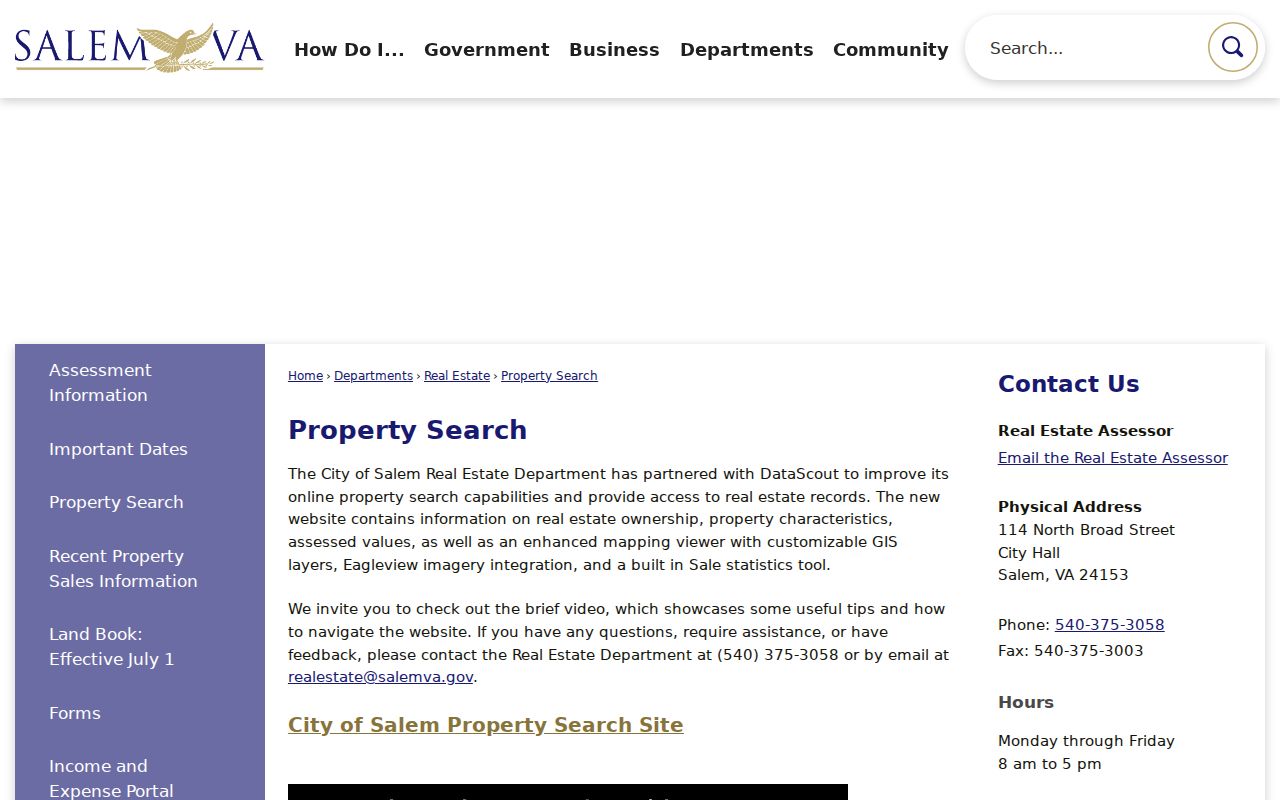
Use the landing page to reach the assessor source itself. Then, if the owner name could be newer than the tax roll, confirm through the clerk's recorded deed.
Confirming Salem’s Current Owner
Matching the tax-roll entry to the most recent deed is how you confirm Salem's current owner. Pull the owner name, parcel number, deed reference, and legal description from the land book first. Then search the grantee name in the clerk's deed records. Compare the property wording on the recorded instrument against the parcel you started with. A name match alone is not enough. If the deed describes a different lot or tract, keep searching. The clerk's index is party-based. A street address by itself is a poor deed key.
- Read the owner, mailing address, map number, and deed reference from Salem DataScout or the matching annual land book.
- Search the owner as grantee in Virginia SRA and compare the instrument date, description, and parcel clue.
- Check whether a later deed, release, correction, or fiduciary instrument changes what the tax row suggests.
- Ask the Salem Circuit Court clerk for an image or certified copy if the online index does not provide the instrument.
- Owner of record
- The name Salem carries on its assessment roll for the stated land-book year.
- Assessment roll
- The City’s annual tax record for ownership, property details, and assessed value.
- Situs and mailing
- The situs is the parcel’s physical place; the mailing address is the notice destination.
- Recording lag
- The time between a deed recording and an assessor update; Salem does not publish a typical number.
Salem Roll Timing After a Transfer
Salem runs annual reassessments, but the tax roll does not change on the day of closing. No official source states a typical delay between recording and a new owner appearing in DataScout or a land book. A deed accepted after an assessment snapshot can therefore be newer than the owner field. Compare the deed's recording date with the land-book year and the current assessor result. Don't guess an update interval.
Three dates often sit in one Salem property file. These are the deed's recording date, the assessment year, and the tax period. The GIS map refreshes on its own as-needed schedule. Updates typically land Friday mornings from 8 to 10 a.m. Each date belongs to a separate system. When the roll and the deed differ, the newest recorded instrument is the better evidence of the current transfer. The Real Estate Department can explain the tax record. Some deeds lead to an earlier owner. The separate Salem former-owner chain follows prior grantees backward.
Salem Owner Names May Use a Fiduciary
A current owner name in Salem may belong to a trust, trustee, LLC, corporation, estate, executor, or administrator. Search the exact wording shown on the deed. Include suffixes and the role that follows a person's name. The Virginia SCC Clerk's Information System can confirm a corporation or LLC's name, status, filing history, and registered agent. A registered agent receives filings. That role does not prove who manages or beneficially owns the property.
When an individual has died, the owner entry may stay unchanged until a deed or distribution is recorded. Salem Circuit Court probate records and a fiduciary deed can explain the transfer route. Recent vital records carry access limits. So treat an eligible official certificate or a public obituary only as a date clue. Then confirm the legal transfer in the land record itself.
Salem Situs and Mailing Addresses Differ
Two different addresses sit on most Salem tax accounts. The situs address pins down the parcel itself. The mailing address only shows where the tax notice travels. In Salem that mailing field can name a trustee, a manager, a business office, a family representative, or a post-office box. It proves neither that the owner lives there nor that the spot falls inside Salem. ZIP 24153 is a postal zone, not a City boundary. When a Salem postal address shows up beyond the municipal line, pull up the City Limits layer and the tax account before drawing conclusions.
Keep the mailing address to lawful property business. Salem GIS does offer a name-removal request for City real-estate sites, though its public page stays quiet on who qualifies and which fields disappear. Granting that request changes no deed, no tax bill, and no court record. Ask the City about the form's scope instead of assuming every official record can be wiped away.
Salem Value Changes Do Not Name a New Owner
Salem's annual reassessment can move the land value, the improvement value, or the total. The owner of record stays identical. A deed can also change hands before the next assessment book catches up. These fields answer separate questions. Value describes a tax estimate; the newest recorded conveyance names the parties to a transfer. A jump in value does not mean a sale happened. An unchanged assessment does not mean no deed was recorded.
Record the land-book year, the owner name, and the deed reference. Keep the latest recording date with them as one set. When a name and a deed seem out of sync, take the question to two offices. Ask the Real Estate Department about the roll. Ask the Circuit Court clerk about the instrument itself. The assessment office can explain its snapshot. Only the recorded instrument confirms what the clerk accepted.
Using Salem Owner Information Lawfully
The Salem owner of record and its mailing address exist for assessment and notice purposes. Treat them that way. If a property matter requires contact, use a proper written channel. Keep personal data to the minimum needed. A tax-roll name can be an entity, a trust, or an agent. The mailing address can belong to someone other than the deed's named owner. When a real decision hangs on the answer, verify the record. Check with the City or the clerk first.
Lawful use. Salem ownership information supports parcel research and due diligence. It must not be used to stalk, threaten, trespass on, or harass a person. Do not treat a tax-roll entry as permission to approach or enter private property.